
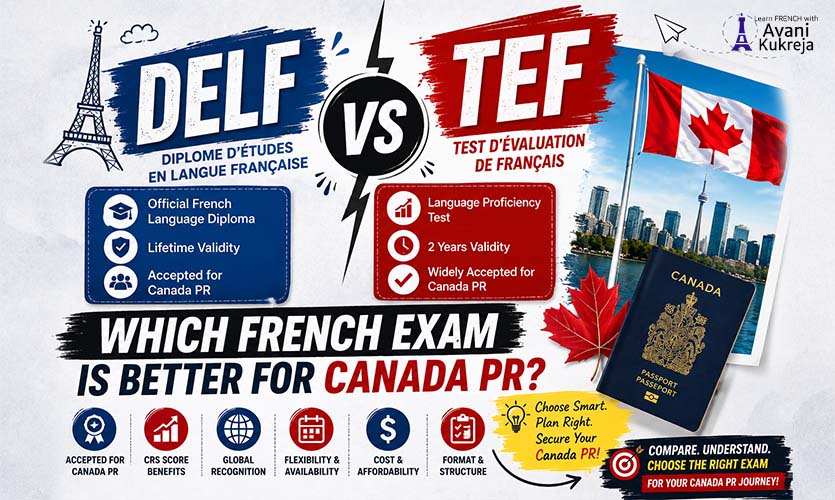
DELF vs TEF: Which French Exam Is Better for Canada PR?
IRCC (Immigration, Refugees and Citizenship Canada) does NOT accept DELF for Express Entry or Canada PR. Only TEF or TCF are officially recognized for Canadian immigration. If your goal is Canada PR, choose TEF — it is the clear winner. DELF is excellent for academic or professional certification in Europe, but it will not earn you a single CRS point for Canada immigration.
Why Choosing the Right French Exam Matters
If you are planning to immigrate to Canada through Express Entry, one wrong exam choice could cost you months of preparation — and zero CRS points. Thousands of aspirants make the mistake of spending time and money on the wrong French test every year.
Here is the good news: French proficiency is one of the most powerful tools available to boost your Comprehensive Ranking System (CRS) score for Canada PR. Scoring NCLC 7 or higher in all four sections of TEF can earn you up to 50 extra CRS points — which can be the difference between receiving an Invitation to Apply (ITA) and waiting indefinitely in the Express Entry pool.
We compare DELF vs TEF across every dimension — exam format, scoring, difficulty, cost, CRS impact, and preparation strategy — so you can make a fully informed decision.
What Is TEF?
TEF, which stands for Test d’Evaluation de Francais Canada, is the official French language proficiency test accepted by Immigration, Refugees and Citizenship Canada (IRCC) for immigration purposes. It is administered by CCI Paris Ile-de-France (Paris Chamber of Commerce) and is the most widely used French exam among Canada PR applicants worldwide.
Key Features of the TEF Exam Explained
- Full name: Test d’Evaluation de Francais Canada
- Administered by: CCI Paris Ile-de-France
- Purpose: Canadian immigration, Express Entry, Quebec PR, citizenship
- Format: 4 mandatory sections — Listening, Reading, Writing, and Speaking
- Scoring: Score-based, adaptive (0 to 450 per skill), mapped to CLB/NCLC levels
- Validity: 2 years from the test date
- Mode: Computer-based with adaptive scoring
- Result time: 4 to 6 weeks
TEF is score-based and adaptive. This means it does not have fixed levels — instead, your score automatically maps to a CEFR and CLB level. This is critically important for immigration because IRCC uses CLB levels (Canadian Language Benchmarks) to calculate CRS points.
TEF remains the most widely accepted option for immigration purposes and is available at more examination centers globally compared to TCF Canada.
Who Should Take TEF Canada?
Anyone applying for Canada PR through Express Entry, Provincial Nominee Programs (PNP), or Quebec immigration programs should take TEF. It is also required for Canadian citizenship applications where French is the primary language.
What Is DELF?
DELF stands for Diplome d’Etudes en Langue Francaise. It is an official French language diploma issued by the French Ministry of National Education. Unlike TEF, DELF is not a placement test — it is a diploma-level certification that is recognized worldwide for academic and professional purposes.
Key Features of DELF
- Full name: Diplome d’Etudes en Langue Francaise
- Administered by: French Ministry of National Education (via France Education International)
- Purpose: Academic certification, university admissions, professional use, career advancement
- Format: Level-based — A1, A2, B1, B2 (each tested separately)
- Scoring: Pass/fail structure — minimum score required per section
- Validity: Lifetime (certificate never expires)
- Result time: 6 to 8 weeks
DELF has four levels: A1 and A2 for beginners, B1 for intermediate learners, and B2 for upper-intermediate level. B2 is the most commonly targeted level for immigration and academic purposes. Unlike TEF, the DELF certificate is valid for life — it never expires.
DELF is widely recognized by French universities, European employers, and international organizations. It is particularly valued for those who want permanent proof of their French ability for careers abroad.
Who Should Take DELF?
DELF is ideal for students planning to study in France or other French-speaking countries, professionals seeking international careers, teachers of French who need permanent certification, and anyone who wants lifetime proof of French proficiency.
What Is the Difference Between DELF and TEF Canada?
Here is a full side-by-side comparison of TEF and DELF across all key criteria:
| Feature | TEF Canada | DELF |
|---|---|---|
| Accepted by IRCC (Express Entry) | Yes | No |
| Certificate Validity | 2 years | Lifetime |
| Test Format | Score-based (adaptive) | Level-based (pass/fail) |
| Levels / Structure | Single test (CLB scale) | A1, A2, B1, B2 |
| Primary Purpose | Canadian Immigration (PR) | Academic / Professional |
| Administered by | CCI Paris Ile-de-France | French Ministry of Education |
| Result Timeline | 4 to 6 weeks | 6 to 8 weeks |
| Approximate Cost | CAD 340 to 400 | Varies by level & country |
| CRS Points for PR | Up to 50 bonus points | No direct CRS points |
| Scoring System | 0 to 450 per skill | Minimum pass per section |
| Retake Policy | Retake entire test | Retake individual sections |
| Difficulty Style | Adaptive, time-pressured | Structured, level-specific |
The most critical difference for Canada PR applicants is acceptance by IRCC. TEF is fully accepted for Express Entry and all federal immigration programs. DELF is not. This single fact makes TEF the mandatory choice for anyone targeting Canadian permanent residency.
Is DELF Accepted for Canada PR?
This is the most common and costly mistake made by French learners targeting Canada PR. Despite DELF being an internationally recognized diploma, Canada’s immigration system requires a placement test (TEF Canada or TCF Canada) that provides a granular score across all language levels. DELF’s pass/fail structure does not give IRCC the level-specific data it needs to calculate CRS points.
What About DELF B2 Equivalence?
DELF B2 roughly corresponds to CLB 7 on the Canadian Language Benchmark scale, which is the magic threshold for maximum CRS bonus points. However, since DELF cannot be officially submitted to IRCC, this equivalence is only academically useful — it does not translate into actual PR points unless you also take TEF or TCF Canada.
How TEF Boosts Your CRS Score
One of the biggest advantages of French proficiency for Canada PR is its direct impact on your CRS score through Express Entry. Here is exactly how it works
The 50 Bonus Points Rule
To gain the maximum 50 CRS bonus points, you need CLB 7 or higher in French (all four sections) AND CLB 5 or higher in English. This bilingual bonus is one of the most powerful score-boosters available in the Express Entry system and can transform a marginal profile into a competitive one.
| CLB / NCLC Level | French + English CLB 5+ | French only (lower English) |
|---|---|---|
| CLB 4 (A2) | 0 bonus points | 0 bonus points |
| CLB 5 (B1 lower) | 1 to 5 points | 1 to 5 points |
| CLB 6 (B1 upper) | 6 to 10 points | 3 to 7 points |
| CLB 7 (B2 lower) | 25 points | 15 points |
| CLB 8 (B2 upper) | 50 points | 25 points |
| CLB 9+ (C1/C2) | 50 points | 25 points |
Understanding B2 Inferior and B2 Superior in TEF Canada
This is a critically important distinction that many candidates miss. TEF has two B2 categories:
- B2 Inferior: Scores at the bottom range of B2 — gives zero bonus points for Express Entry
- B2 Superior: Scores at the upper range of B2 and above — gives the full 50 bonus points
This means you need to aim well above the minimum B2 threshold on TEF to actually benefit from the CRS bonus. Scoring exactly at the boundary can result in B2 Inferior, leaving you with no additional points despite reaching B2 level.
TEF vs DELF: Which French Exam Is More Difficult?
A very common question among French learners is: Which exam is harder, TEF or DELF? The honest answer depends on your learning style and preparation method.
Why TEF Is Considered Harder
- Adaptive scoring: Questions get harder as you do better, making the test unpredictable
- Strict time pressure: The clock never stops and sections follow each other rapidly
- Fast-paced listening: Audio clips include various French accents including Quebecois
- Computer-based: Requires comfort with digital testing environments
- No level selection: You cannot choose which level to attempt
Why DELF Is Considered More Manageable
- Level-specific: You choose exactly which level (B1 or B2) to sit for
- Pass/fail: No adaptive difficulty — questions stay at the chosen CEFR level
- Structured writing: More time for organized written responses with pauses
- Predictable format: The exam structure is consistent across sessions
- Academic depth: Rewards strong grammar and vocabulary knowledge
TEF is generally considered harder because it is adaptive and measures your exact proficiency without fixed levels. DELF B2, on the other hand, is level-based, so candidates prepare specifically for their target level — making it more predictable and easier to plan for.
TEF vs DELF Exam Format Explained
TEF — Exam Format
TEF consists of four mandatory sections that must all be completed. You cannot skip any section for immigration purposes.
- Listening Comprehension: 40 questions, approximately 40 minutes. Includes dialogues, radio-style clips, and announcements.
- Reading Comprehension: 50 questions, approximately 60 minutes. Includes advertisements, news articles, letters, and formal texts.
- Written Expression: 2 tasks, approximately 60 minutes. Includes writing a formal email or letter and a news flash-style task.
- Oral Expression: 3 tasks, approximately 15 minutes. A face-to-face or recorded interview on given topics.
TEF covers all four skills over roughly 3 hours of testing. It is computer-based and uses adaptive scoring — meaning the difficulty of questions adjusts based on your performance.
DELF B2 — Exam Format
DELF B2 (the most relevant level for immigration comparisons) consists of the same four skills but in a different structure:
- Listening: 3 to 4 documents, approximately 30 minutes. Based on radio broadcasts, reports, and interviews.
- Reading: 3 to 4 documents, approximately 60 minutes. Includes newspaper articles, opinion pieces, and reports.
- Writing: 2 tasks, approximately 60 to 90 minutes. Includes a formal letter and a well-structured argumentative essay.
- Speaking: Approximately 20 minutes. Includes a monologue on a given topic followed by a discussion with the examiner.
DELF B2 covers the same skills but splits the exam with pauses between sections, giving candidates more breathing room. The total test time is approximately 2.5 hours.
Cost Comparison Between TEF and DELF Exams
Cost is always a practical consideration when choosing between exams. Here is what you can expect
TEF Cost
- Typical cost: CAD 340 to CAD 400 depending on the test center location
- All four sections are mandatory — no modular pricing for immigration versions
- Rescheduling fees may apply if you change your test date
- Preparation course costs: CAD 150 to CAD 500 for structured programs
DELF Cost
- Varies significantly by country and level (A1, A2, B1, B2)
- B2 level typically costs INR 5,000 to INR 8,000 in India
- In France, costs range from 50 to 100 Euros depending on the center
- You pay per level — so if you fail and retake, you pay again
While both exams are similar in cost when you account for preparation, TEF provides a far better return on investment for Canada PR candidates. The 50 CRS bonus points from TEF can dramatically shorten your wait time for an ITA, making the cost well justified.
TEF vs TCF Canada
Many candidates are also unsure about the difference between TEF and TCF Canada. Both are accepted by IRCC for Express Entry — but they are not identical.
Key Difference: The B2 Inferior Problem
This distinction is critical for CRS strategy. As mentioned earlier, TEF has a B2 Inferior category that gives zero bonus CRS points. TCF Canada does NOT have a B2 Inferior category. This means that any B2 score on TCF Canada qualifies for the full 50 bonus CRS points, whereas the same score on TEF might fall into B2 Inferior and give zero bonus points.
Which Should You Choose: TEF or TCF?
- Choose TEF: You have access to more preparation materials, prefer a wider selection of test centers, or are targeting Quebec immigration
- Choose TCF: You prefer structured multiple-choice reading and listening tasks, want to avoid the B2 Inferior risk, and are comfortable with progressive difficulty questions
Both exams typically cost between CAD 340 and CAD 400 depending on the test center. Cost should not be the deciding factor. We recommend reading our dedicated TEF vs TCF comparison guide for a full analysis.
Can DELF Preparation Help You Score Better on TEF ?
Absolutely — and this is one of the smartest strategies an aspirant can follow.
Even though DELF certification itself cannot be submitted to IRCC, the skills you build through DELF preparation directly strengthen your TEF performance. Here is why:
- Grammar Foundation: DELF preparation teaches you to master tenses, sentence structures, and connectors. Without this foundation, TEF writing and speaking answers often fall apart under time pressure.
- Opinion Expression: In DELF B1/B2 training, you learn to express ideas, justify arguments, and debate politely. This is exactly what TEF writing and speaking tasks expect for CLB 7 or higher.
- Listening to Authentic French: DELF listening sections use radio extracts, interviews, and news reports — the same kind of material used in TEF. This familiarity reduces stress on test day.
- Oral Confidence: DELF oral exams are like practice matches for TEF speaking. They train you to speak clearly, confidently, and with proper structure.
Many successful candidates use this two-step strategy: build their French foundation with DELF-level preparation (targeting B1 to B2), then take a 4-week bridge course to master the specific format and mechanics of TEF or TCF Canada. This approach consistently produces higher scores than jumping directly into TEF-only preparation.
Which French Exam Should YOU Choose?
After analyzing all the key factors, here is a simple decision framework based on your specific goal:
| Your Goal | Right Exam |
|---|---|
| Canada PR via Express Entry | TEF Canada or TCF Canada |
| Quebec Provincial Immigration | TEF Canada / TEFAQ |
| Study in France or Europe | DELF B2 or DALF C1 |
| Work in French-speaking countries | DELF B2 |
| Permanent lifetime French certificate | DELF (lifetime validity) |
| French citizenship in France | TCF |
| Best of both worlds | DELF preparation + TEF Canada exam |
The Smart Dual Strategy
For serious aspirants who want the best of both worlds, there is a powerful combined approach. Take TEF Canada or TCF Canada now to secure your Canada PR and claim your CRS bonus points. Later, once you have settled in Canada, prepare for DELF B2 or DALF C1 to strengthen your career profile, academic credentials, and long-term professional opportunities.
This way, you do not just learn French for immigration points — you invest in a skill that stays with you and opens doors globally throughout your career.
Top Preparation Tips for TEF
If you have decided that TEF is your exam — which it should be if Canada PR is your goal — here are the most effective preparation strategies to maximize your CLB score:
Timeline and Planning
- Start at least 3 to 6 months before your target test date
- Assess your current French level first (take a free online CEFR placement test)
- If you are below B1 level, allocate more time — rushing leads to poor scores
- Book your exam slot 6 to 8 weeks in advance, especially during peak immigration seasons
Section-Specific Strategies
- Listening: Train your ear to Quebecois and European French accents. Listen to Radio-Canada, RFI, and French YouTube channels daily.
- Reading: Practice skimming long passages quickly. Focus on identifying the main argument and supporting details within time limits.
- Writing: Master the news flash format unique to TEF Canada. Practice formal letter writing with strict word counts.
- Speaking: Record yourself speaking on general topics. Focus on fluency and clarity over perfect grammar.
Resources for TEF Canada Preparation
- Official TEF Canada preparation portal and sample tests
- Preparation au TEF by CCI (approximately INR 2,000) — full mock tests with audio
- Le TEF en Pratique — comprehensive practice for all four sections
- Alliance Francaise preparation courses (in-person or online)
- Anki flashcard decks for French vocabulary building
Common Mistakes to Avoid
Avoiding common errors can dramatically improve your score. Here are the biggest mistakes to avoid in TEF and TCF exams.
- Do not focus only on grammar — communicative fluency matters more on TEF Canada
- Do not skip the speaking section in practice — it requires real-time confidence
- Do not underestimate the listening section — Quebecois accents can be challenging
- Do not prepare for DELF thinking it will help you directly with IRCC — it will not
Conclusion
If Canada PR is your goal, TEF is not just better — it is the only valid option. DELF will not earn you CRS points, will not be accepted by IRCC for Express Entry, and will not help you get your Invitation to Apply.
Here is your complete action plan:
- Assess your current French level using a free CEFR placement test
- Begin structured French preparation using DELF B2-level materials for a solid foundation
- Transition to TEF-specific preparation 4 to 6 weeks before your exam date
- Book your TEF exam slot well in advance
- Target CLB 8 to ensure you land in B2 Superior territory for the full 50 CRS bonus points
French proficiency is one of the most underutilized tools in the Canadian immigration toolkit. With the right preparation and the right exam, those 50 extra CRS points could make your Canadian dream a reality far sooner than you expected
Frequently Asked Questions
For maximum CRS bonus points, you need CLB 7 or NCLC 7 in all four sections of TEF Canada. This requires approximately 310 to 349 points per skill section on the TEF Canada scale. However, to avoid the B2 Inferior trap and securely claim all 50 CRS bonus points, target CLB 8 (approximately 350 to 450 per section).
Yes, TEF Canada is generally considered harder because it is adaptive and places you under strict time pressure without fixed levels. DELF is level-based, so you choose the level you are ready for, making it more predictable and structured. For most learners, DELF B2 feels easier to prepare for.
TEF Canada results are valid for 2 years from your test date for Canadian immigration purposes. IRCC requires valid scores at both the time of application submission and during processing. If your score expires during processing, you will need to retake the test.
Both TEF Canada and TCF Canada are accepted by IRCC. The key difference is that TEF Canada has a B2 Inferior category that gives zero CRS bonus points, while TCF Canada does not — any B2 score on TCF Canada earns the full 50 CRS bonus points. TEF Canada has more test centers and preparation resources.