
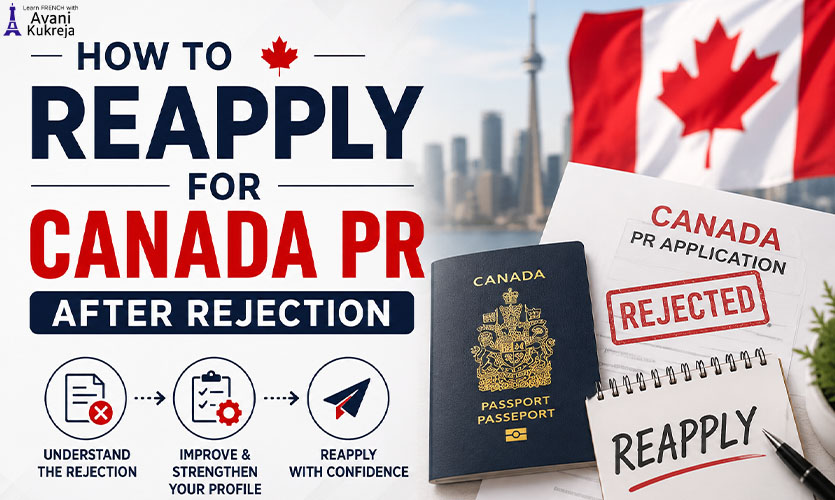
How To Reapply If Your Canada PR Application Gets Rejected?
Planning to move to Canada is an exciting milestone, but receiving a rejection for your permanent residence (PR) application can feel discouraging.
The good news is that a rejected application does not mean your dream of immigrating to Canada is over. Every year, many applicants successfully obtain Canadian permanent residence after correcting the issues that led to their initial refusal.
Whether your application was rejected because of missing documents, a low Comprehensive Ranking System (CRS) score, eligibility concerns, or incorrect information, understanding the reason behind the refusal is the first step toward submitting a stronger application.
In this guide, you’ll learn why Canada PR applications are rejected, whether you can reapply, the exact steps to take after receiving a refusal, and practical tips to improve your chances of approval.
If you’re applying through Express Entry or another immigration pathway, this article will help you prepare a stronger application and avoid repeating the same mistakes.
Can You Reapply for Canada PR After Rejection?
Yes, you can reapply for Canada PR after your application is rejected. In most cases, there is no mandatory waiting period. However, before submitting a new application, you must carefully review the refusal letter, identify the reason for rejection, correct all issues, and ensure your new application meets the latest Immigration, Refugees and Citizenship Canada (IRCC) requirements.
Why Do Canada PR Applications Get Rejected?
Understanding why your application was refused is essential because it helps you avoid making the same mistakes again.
Canada PR applications may be rejected for several reasons, ranging from documentation errors to eligibility issues.
Here are some of the most common reasons:
| Reason for Rejection | How to Fix It |
|---|---|
| Missing or incomplete documents | Canadian PR and citizenship |
| Incorrect information | All four skills equally |
| Low CRS Score | Varies by immigration program |
| Expired language test results | Nationwide (Canada) |
| Medical inadmissibility | Complete additional medical requirements if applicable. |
| Criminal inadmissibility | Submit the required legal documents and rehabilitation records. |
| Misrepresentation | Always provide truthful and accurate information. |
| Insufficient proof of funds | General Canadian immigration applicants |
Many applicants assume their application was rejected because they were not eligible, but in reality, simple mistakes such as uploading the wrong document, forgetting a signature, or providing outdated information can also lead to refusal.
What Happens After Your Canada PR Application Is Rejected?
When Immigration, Refugees and Citizenship Canada (IRCC) refuses your application, you will receive an official refusal letter explaining the reason for the decision. The refusal letter is one of the most important documents because it tells you exactly what needs to be corrected before submitting another application.
Depending on your immigration pathway, you may have different options after rejection.
These may include:
- Correcting your application and reapplying.
- Improving your CRS score before creating a new Express Entry profile.
- Applying through another eligible immigration program.
- Seeking professional immigration advice if the refusal is complex.
In most Express Entry cases, applicants cannot appeal the refusal. Instead, they should focus on correcting the issues and preparing a stronger application.
Can You Reapply for Canada PR After Rejection?
Yes, A Canadian PR rejection does not permanently prevent you from applying again.
Many successful immigrants receive approval after their second or even third application because they addressed the issues identified in the refusal letter.
Before reapplying, ask yourself these questions:
- Did I understand the exact reason for my rejection?
- Have I corrected every issue mentioned by IRCC?
- Are all my documents current and complete?
- Has my CRS score improved?
- Are my language test results still valid?
- Do I now meet all eligibility requirements?
If the answer is “yes” to these questions, you are ready to prepare a stronger application.
Step-by-Step Guide to Reapply for Canada PR
Submitting another application without fixing previous mistakes can result in another refusal. Follow these steps carefully to maximize your chances of approval.
Step 1: Carefully Read Your Refusal Letter
The first thing you should do is read your refusal letter several times.
Avoid making assumptions about why your application was rejected. Instead, focus on the exact explanation provided by IRCC.
Some applicants rush to submit another application immediately, but understanding the refusal reason first can save time and money.
Step 2: Identify the Exact Reason for Rejection
Once you’ve reviewed the refusal letter, categorize the issue.
Common reasons include:
- Missing supporting documents
- Expired language test
- Low CRS score
- Incorrect employment history
- Inadequate proof of funds
- Medical concerns
- Criminal inadmissibility
- Misrepresentation
Knowing the exact problem allows you to create an action plan instead of repeating the same mistakes.
Step 3: Correct Every Issue Before Reapplying
This is the most important step.
Many applicants simply submit the same documents again, hoping for a different result. Unfortunately, this usually leads to another refusal.
Instead, correct every issue mentioned in your refusal letter.
For example:
Missing Documents: Double-check your document checklist and upload every required file before submitting your application.
Low CRS Score: If your CRS score was below the invitation cutoff, consider improving your profile by:
- Retaking your language test.
- Gaining additional work experience.
- Completing another educational credential.
- Applying for a Provincial Nominee Program (PNP).
Even a small increase in your CRS score can significantly improve your chances of receiving an Invitation to Apply (ITA).
Language Test Scores: Many applicants underestimate the importance of language proficiency.
Improving your IELTS, CELPIP, or TEF Canada score can increase your CRS points and strengthen your Express Entry profile.
If you’re planning to earn additional CRS points through French, preparing for the TEF Canada exam with expert guidance can make a meaningful difference. Learning French not only improves your language skills but can also open additional immigration opportunities for eligible candidates.
Incorrect Employment Information: Ensure that your work experience matches the correct National Occupation Classification (NOC) code.
Your employment letters should clearly describe your duties, working hours, salary, and employment period.
Step 4: Update Your Supporting Documents
Before submitting your new application, review every document carefully.
Update any document that has expired or changed since your previous application.
These may include:
- Passport
- Educational Credential Assessment (ECA)
- IELTS, CELPIP, or TEF Canada results
- Police Clearance Certificate
- Medical examination
- Proof of funds
- Employment reference letters
- Marriage certificate (if applicable)
Submitting updated documents demonstrates that your application is complete and accurate.
Step 5: Create a New Express Entry Profile
If your previous Express Entry application was refused, you’ll usually need to create a new Express Entry profile.
While creating your new profile:
- Update your education details.
- Add new work experience.
- Include improved language scores.
- Declare all previous visa refusals honestly.
- Review every section carefully before submission.
A stronger profile significantly increases your chances of receiving another Invitation to Apply.
Step 6: Consider Other Immigration Programs
If Express Entry is no longer the best option, explore other Canadian immigration pathways.
Some alternatives include:
- Provincial Nominee Program (PNP)
- Canadian Experience Class (CEC)
- Federal Skilled Worker Program (FSWP)
- Federal Skilled Trades Program (FSTP)
- Atlantic Immigration Program (AIP)
- Family Sponsorship
- Rural and Northern Immigration pathways
Choosing the right immigration stream can improve your chances of successfully becoming a permanent resident.
Documents Required Before Reapplying for Canada PR
Before submitting a new Canada PR application, make sure all your supporting documents are complete, accurate, and up to date. Even a small error or expired document can delay your application or lead to another rejection.
Use the checklist below before applying again:
| Required Document | Why It Matters |
|---|---|
| Valid Passport | Confirms your identity and travel eligibility. |
| Educational Credential Assessment (ECA) | Verifies that your education meets Canadian standards. |
| Language Test Results (IELTS, CELPIP, or TEF Canada) | Demonstrates your English or French language proficiency. |
| Proof of Work Experience | Confirms your skilled employment history. |
| Police Clearance Certificate | Shows you meet Canada's security requirements. |
| Medical Examination Report | Confirms you meet medical admissibility requirements. |
| Proof of Funds | Demonstrates you have enough financial resources to settle in Canada. |
| Marriage or Birth Certificates (if applicable) | Supports family-related information in your application. |
Common Mistakes to Avoid After Canada PR Rejection
Many applicants repeat the same mistakes after receiving a refusal. Avoiding these common errors can significantly improve your chances of approval.
Reapplying Without Understanding the Refusal Reason – Your refusal letter explains exactly why your application was rejected. Ignoring it often leads to another refusal.
Submitting the Same Documents Again – If your application was rejected because of missing or incorrect documents, simply uploading the same files will not solve the problem.
Update every document before reapplying.
Not Improving Your CRS Score – If your CRS score was below the cutoff, submitting another Express Entry profile without improving your score is unlikely to produce a different outcome.
Work on increasing your score first.
Ignoring Language Test Improvements – Language scores have a significant impact on Express Entry.
Many applicants successfully increase their CRS score by improving their IELTS or TEF Canada results before applying again.
Missing Application Deadlines – If IRCC requests additional documents or information, respond as quickly as possible.
Missing deadlines can result in delays or application refusal.
Conclusion
A Canada PR application rejection is not the end of your immigration journey. By understanding the reason for your refusal, correcting the issues, and submitting a stronger application, you can improve your chances of success.
Before reapplying, carefully review your documents, ensure you meet the latest eligibility requirements, and take steps to strengthen your profile.
If you’re looking to boost your CRS score, improving your French language skills through the TEF Canada exam can provide a valuable advantage. Learn French with Avani offers expert online French courses to help you prepare confidently and move one step closer to your Canada PR goals.